
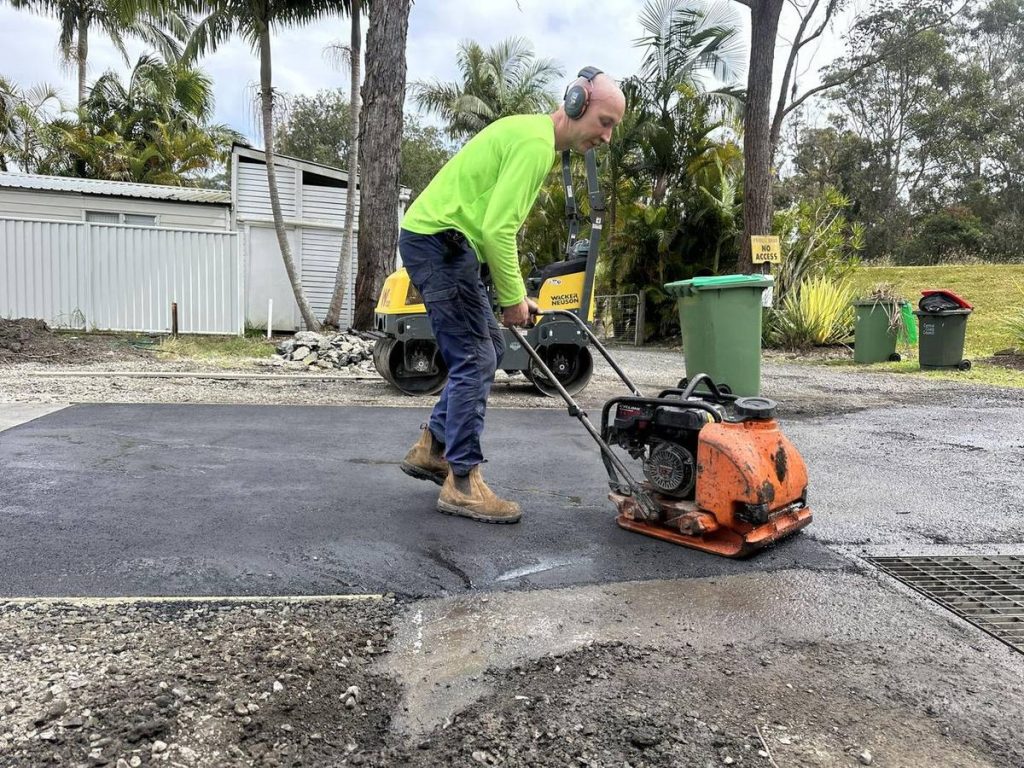
A pothole in a car park won’t fix itself, and it rarely stays one pothole. Water gets under the asphalt, traffic works it loose, and the damaged area can spread.
At a school, a shopping strip or an industrial unit, that means trip hazards, damaged tyres and complaints. It also makes the site look neglected.
This guide is for business owners, school business managers, strata committees and property managers. It covers what a proper patch repair involves, roughly what it costs, and how we fit the work around your opening hours.
Price your repairs in 2 minutes
Tell us roughly how big the damaged areas are and what drives on them, and get an instant price range. Photos help us confirm it.
Why car park asphalt fails
Almost every failure we’re called to on the Coast comes down to one of four things:
- Water. Ponding, blocked pits or no fall. Water softens the base, then the asphalt above breaks up.
- Heavy or turning vehicles. Buses, delivery trucks, bin trucks and forklifts turning on asphalt built for cars.
- Thin or poor original construction. Asphalt laid over unprepared ground.
- Age. Asphalt becomes brittle with age. Crocodile cracking (a pattern like reptile skin) can be a sign the base underneath has failed, and needs checking.
Before you choose a repair, find the cause. Patching a hole caused by a blocked pit means paying twice.
From a recent job: a school turning area
A failed patch at a school had been laid far, far below spec by the previous contractor, in a spot with heavy traffic and turning. “A high turning point is really difficult on asphalt: a lot of traffic turning, or trucks coming in for the bins. Plus the asphalt being too thin just meant it was never going to last.” You see the same thing in car parks.
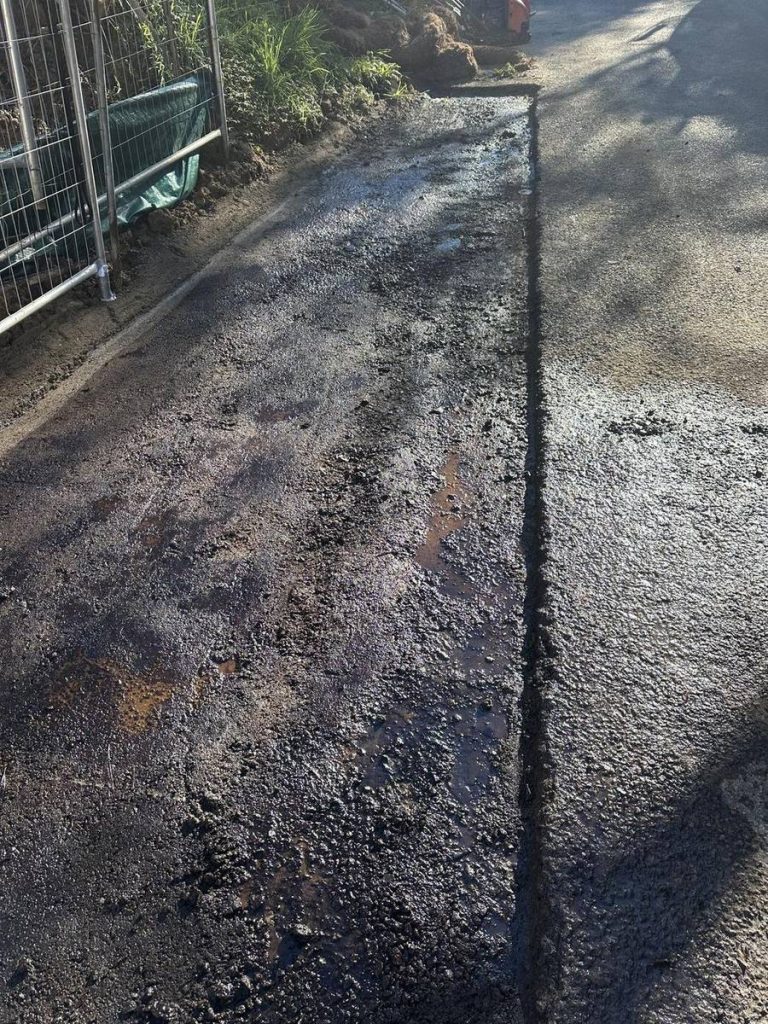
Other patches fail from underneath. “Over time, with rain and traffic driving over them, clay will start to come up through it. Sometimes we have to stabilise the base and dig it out a bit thicker, to make sure there’s a solid base over the clay.” – Nathan
How a proper patch repair works
- Saw-cut a clean square or rectangle around the failed area, into sound asphalt.
- Dig out the broken asphalt and any soft base, and take it to the tip.
- Rebuild the base with compacted road base where it has failed.
- Tack coat the edges so the new asphalt bonds.
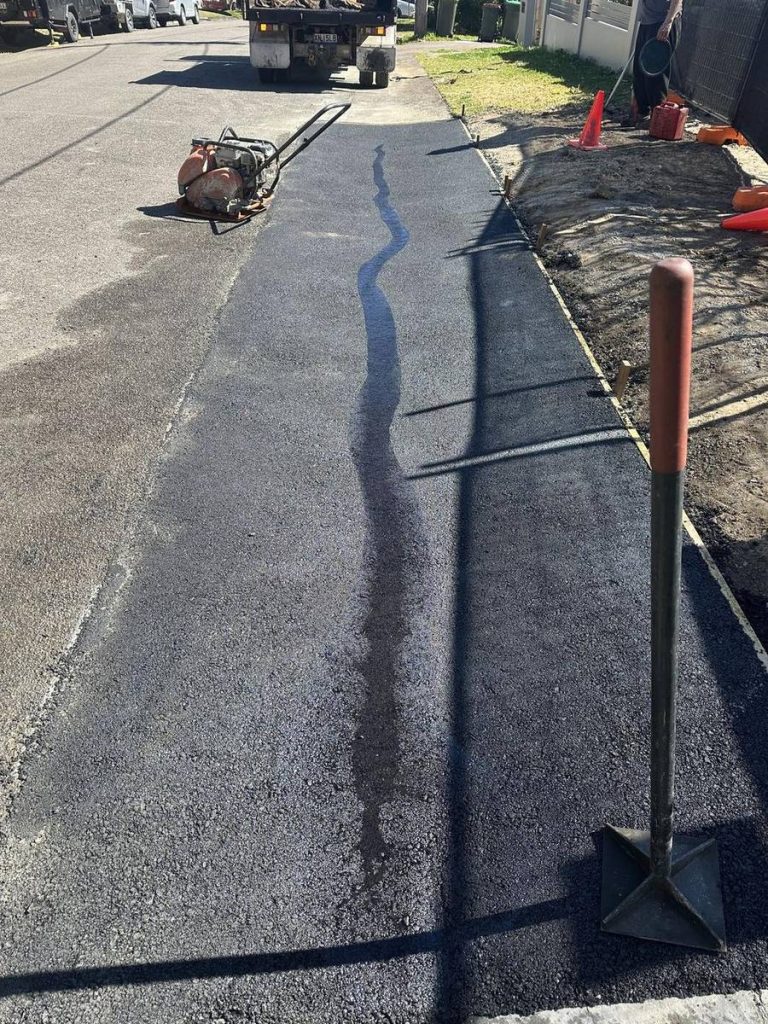
- Lay hot-mix asphalt and roll it level with the surrounding surface.
- Seal the joins where needed to keep water out.
Standard patches are 40–50mm of asphalt. For areas where buses, trucks or bins turn, our guide is a deep lift of about 100mm. We also check the base and drainage, because depth alone won’t stop a patch failing. Heavy-duty yards used by forklifts or semi-trailers need a pavement designed for the site. If you have an engineer’s specification, send it with your request.
What it costs
| Repair | Typical size | Price guide (inc GST) | Price guide (ex GST) |
|---|---|---|---|
| Single pothole or small failed area | 1–10 m² | About $3,500 – $4,750 | About $3,200 – $4,300 |
| Several patches on one site, same day | 20–30 m² in total | About $4,500 – $6,650 | About $4,100 – $6,050 |
| Deep-lift patching for truck or bus areas | 10–30 m² | About $4,150 – $8,150 | About $3,750 – $7,400 |
| Larger failed sections of a car park | 80–120 m² | About $10,350 – $19,100 | About $9,400 – $17,350 |
Estimates from our instant estimator, built from our 2026 Central Coast jobs. Your price is confirmed after we’ve seen photos or the site.
Want a figure for your site? Estimate my patch repairs.
Group your repairs to save money. Most of the cost of a small patch is getting the crew, machines and hot asphalt to site. Fixing every failed area in one visit costs far less than calling us back three times.
Why not just cold-mix the holes? Bagged cold-mix is useful as a temporary fill until a proper repair is booked. It doesn’t bond or compact like hot mix, so on busy areas it often needs redoing. “Cold mix is only temporary anyway, so it’s never going to last. It’s usually the business owner who puts it in, to save money. They might fill it a few times, but eventually they call us. It’s meant to be a temporary band-aid fix, and I can understand people wanting to save money.” – Nathan
Bigger than that? Our instant estimator covers areas up to about 150 m². Larger areas are priced after a site visit, and for full car park reconstruction we can point you to a contractor set up for that scale.
Patch, resurface or rebuild?
- Patch when the damage is in separate spots and the pavement around them is sound.
- Resurface when the surface is worn or cracked across a wide area but the base is still firm.
- Rebuild when the base has failed across large areas, often shown by widespread crocodile cracking or sinking.
We’ll tell you which one your site needs. Patching a car park that really needs rebuilding wastes money.
“I’ll go to some jobs and customers will say, I’ve got five or six patches. Honestly, at that point it’s not worth it. It takes so long to cut out and prepare all those small patches. A lot of the time you’re better off doing a big section: it’s quicker, more cost-effective and more durable. If you patch something that’s falling apart, the parts around those patches will eventually fail. And when they fail, the edges of the patch start failing too, because they’re no longer supported.” – Nathan
Working around schools and businesses
- Schools: we do school-holiday work, when there are no students or buses on site.
- Businesses: we do night shifts, and we work with the owner to find the best time.
- If it has to be during the day: we set up traffic control and signage, and do letterbox drops for neighbours.
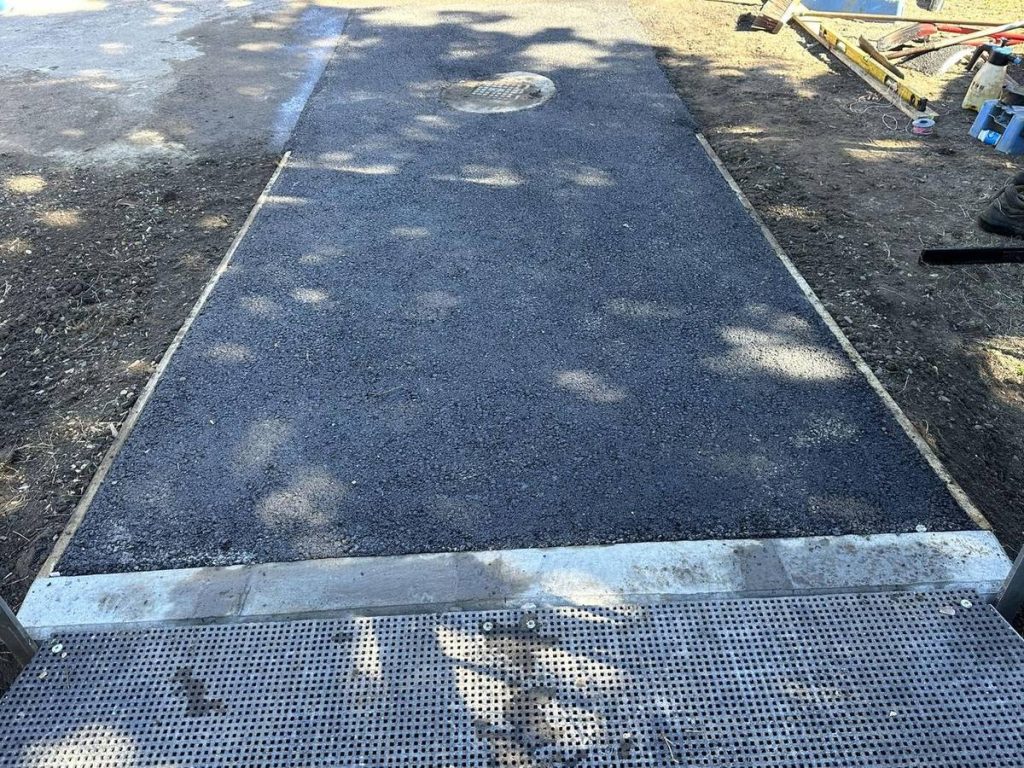
- Back in use fast: hot-mix asphalt can usually carry traffic once it has cooled. We’ll confirm when each area can reopen.
- Usually one day: most patch jobs up to about 30 m² are done in a single day.
Tell us your hours, holiday dates and delivery or bus times when you ask for a price, and we’ll plan around them.
What customers say: rated 4.7 from 46 Google reviews
“He impressed me with his professionalism and delivery of service, arrived when expected and finished on time.”
– Kathy P., Google review
“It started with clear and prompt communication and a detailed and competitive quote followed by a job well done even though we got knocked back by the recurring rain a little.”
– Andrea B., Google review
Don’t let a known hazard sit
Potholes can create risks for customers, staff and students. A pothole that has been reported and left is a risk worth taking seriously.
Assess the hazard, restrict access where needed, and record what you did. Then book a repair. Photos of the damage, the date you noticed it and the repair invoice are good records to keep. (This is general information, not legal advice. Talk to your insurer if a claim has been made.)
What to send for a fast price
- A photo of each failed area, plus one wide shot of the site
- Rough size of each area (length × width)
- What drives on it: cars only, buses, delivery trucks or forklifts
- Opening hours, holiday dates and any times the site can’t be disrupted
- Your business or school name (and ABN, if you have it handy)
FAQ
What size jobs do you do?
Everything from a single pothole (from about $3,500 including GST, or $3,200 + GST) to failed sections of around 150 m². A site can have several repair areas done in one visit.
How long does a patch repair last?
It depends on preparation, drainage, traffic and the condition of the pavement around it. That’s why we look for the cause before recommending a repair.
Can you work in the school holidays?
Often, yes. Ask early, because holiday weeks fill up quickly.
Do you work for strata and property managers?
Yes. We can provide quotes in the format your committee or managing agent needs, and keep a record of each repair for your maintenance file.
Can you line-mark after the repair?
We focus on the asphalt. We’ll leave the surface ready for your line marker, and we can recommend one.
Ready for a number?
Get an instant price range for your patch repairs now. We’ll plan the work around your opening hours.
Coast Pave Asphalt repairs asphalt for schools, car parks and commercial sites in Gosford, West Gosford, Erina, Tuggerah, Wyong, Bateau Bay, The Entrance, Toukley and surrounds. See our asphalt patch repairs and car park repairs services.