
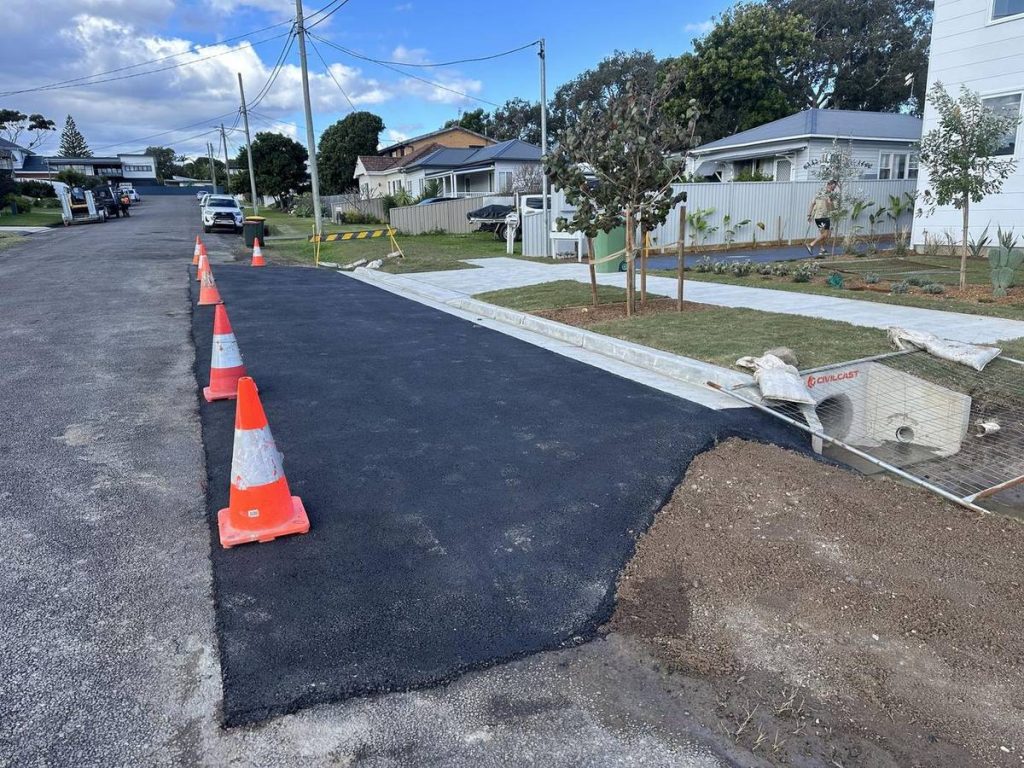
The crossover is the strip of driveway between your property boundary and the road. It sits on council land, so Central Coast Council decides how it’s built. Council calls it a Vehicle Access Crossing (VAC).
It’s also the part most likely to hold up a job. This guide explains what’s involved, what to have ready and how it affects your price, so nothing catches you out halfway through.
Does my job need council approval?
Council approval is needed to build or rebuild a vehicle access crossing, whether or not your street has kerb and gutter.
| Situation | Council approval needed? |
|---|---|
| New driveway or resurface entirely inside your boundary | Usually no |
| New crossover, or widening an existing one | Yes |
| Rebuilding or resurfacing the crossover (including concrete to asphalt) | Yes |
| Any work to the kerb (new layback, kerb cut) | Yes |
| Small patch repair to an existing crossover | Check with Council first |
A development approval, complying development certificate or construction certificate is not the same as VAC approval. You still need the VAC approval before work starts.
Requirements and fees change, so confirm the details on Central Coast Council’s Vehicle Access Crossing page.
Planning a crossover? See your price in 2 minutes
Get an instant price range that includes our council inspection allowance. It doesn’t include Council’s fees or a concrete layback.
How the process works
- Apply to Council. Lodge the VAC application form with a drawing of the crossing and the application fee. Council has a drawing template on its website. A non-standard crossing that needs engineering design can attract an extra fee.
- Council approves the crossing. Read the approval before you book a contractor. It sets the location, width and levels.
- First inspection, before the surface goes down. Council’s form calls this the formwork inspection. The crossing must be set out and ready on a compacted base. Book it at least 48 hours (two business days) ahead.
- Build within 14 days. After a successful first inspection, Council expects the work to be finished within 14 days.
- Final inspection and sign-off. Book this one at least 48 hours (two business days) ahead too. Keep the approval and sign-off with your property records. They matter when you sell.
Check Council’s current processing time before you lock in a construction date.
Nathan’s tips for the application
“In our experience it costs about $500 and takes a week or two. It’s pretty straightforward, and you can fill it all out yourself. It asks for some specific things, like a drawing and a traffic control plan. For the drawing, give it rough dimensions, say five by seven, and roughly sketch your driveway shape. For the traffic control plan, write that your contractor will take care of it. We do that for our jobs.” Fees and requirements change, so check the current ones on Council’s page.
What Council’s standard says about asphalt crossovers
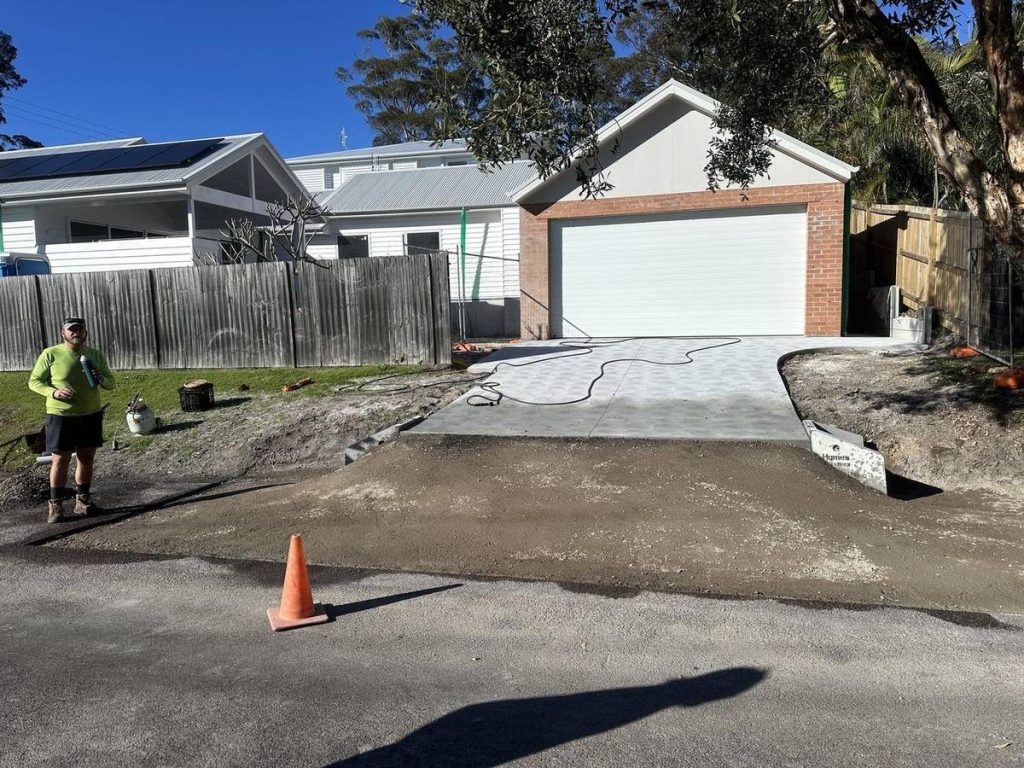
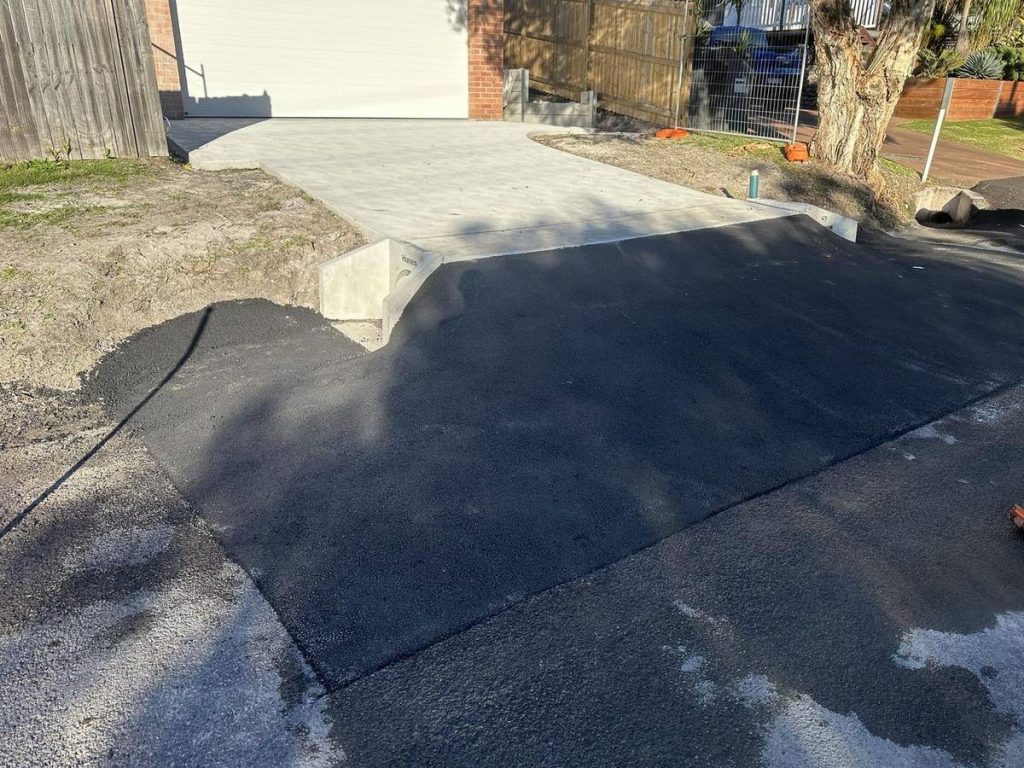
Council’s VAC application form lists asphalt, 40mm minimum as an approved surface. Its standard drawing for an asphalt crossing shows:
- 40mm minimum asphalt on a tack coat
- 100mm minimum compacted road base on firm subgrade
The layback (the dip in the kerb) must be plain concrete. Where a layback is needed, it’s concrete even if the crossing itself is asphalt.
Which finishes does Council allow? Council’s form approves asphalt (40mm minimum), plain concrete, coloured concrete and stencilled concrete (125mm). It won’t approve pavers, tiles, exposed aggregate or stamped concrete on the crossing. If Council or a utility later digs it up, Council restores it in plain concrete. With asphalt or decorative concrete, you sign a waiver accepting that, and any cost to match the original finish is yours. Maintaining the crossing is the property owner’s responsibility under the Roads Act. (Source: Council’s Vehicle Access Crossing application form.)
Concrete is also approved for the crossing itself, at 125mm thick. Asphalt is fast to lay and blends with an asphalt driveway behind it. We’ll confirm when cars can use it, including any wait for new concrete.
Getting the levels right
Most of the crossovers we build are inspected by Council. “We generally get all the plans beforehand. And because we’ve been doing them for years, we’ve built a relationship with the inspectors, so things usually run pretty smoothly. Some are fussier than others. We just take our time making sure we get the levels and fall correct.”
The specifications are strict. Whether the crossing is a high-profile or low-profile design dictates how much fall it needs over the first couple of metres. That fall does two jobs: it carries water away from your property, and it stops cars scraping.
When levels are wrong, it shows. “One of the biggest call-outs we get is cars scraping, or water running into a property.” Those fixes are often purely functional. In Ettalong, for example, a lot of streets have no kerb and gutter and no drainage, so many of our jobs there are about reducing how much water runs off the road into the property when it rains or floods.
Why crossovers cost more than the same area of driveway
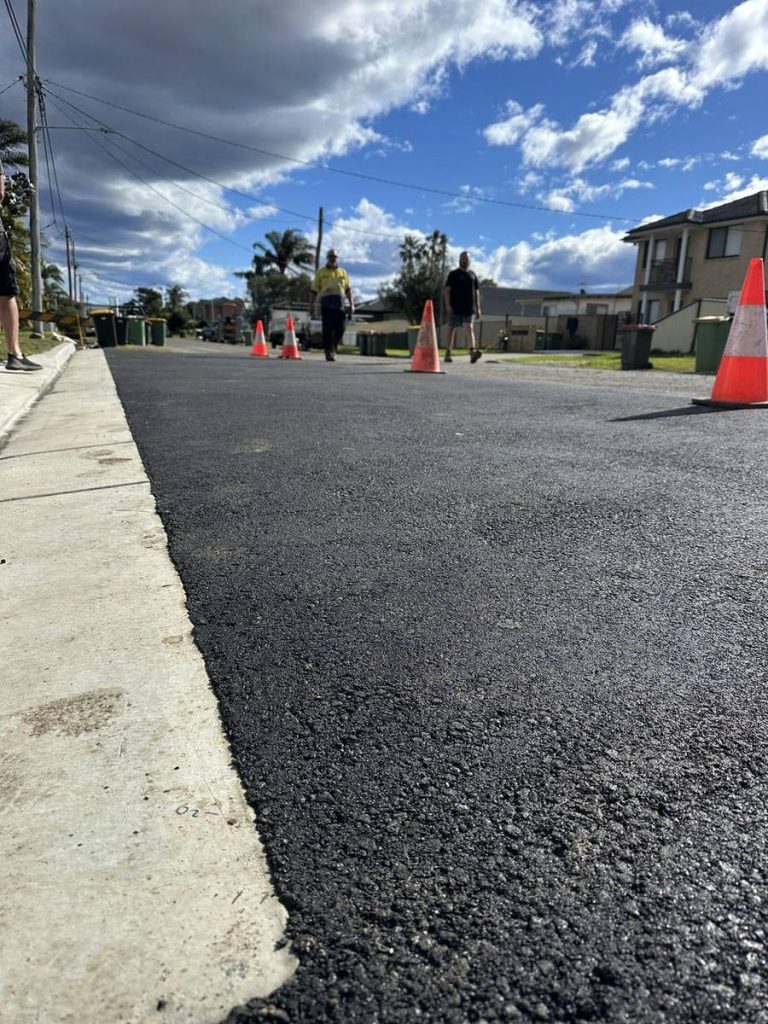
Square metre for square metre, a crossover costs more than the driveway behind it:
- Inspection time. The crew and machines can sit idle waiting for an inspection window. We allow $495 including GST ($450 + GST) for this on crossover jobs, which covers about an hour and a half of crew and plant time.
- Levels and kerb tie-in. Matching Council levels at the kerb and footpath, and keeping the gutter flowing, is fiddly work.
- Traffic control. Busy roads may need traffic control, which is priced separately.
- Council fees. Application and inspection fees are paid to Council and aren’t part of our price.
As a guide: a crossover and driveway of about 30 m² in total typically costs around $5,850–$6,700 including GST (about $5,300–$6,100 + GST). That includes our inspection allowance but not Council’s fees or a concrete layback. Your price depends on size, levels and what’s being removed.
What customers say: rated 4.7 from 46 Google reviews
“Had Nathan and the team complete the crossover on our driveway, very neat and tidy job and passed all the council regulations…”
– Zac T., Google review
What to have ready before you ask for quotes
- Your council approval or application number (or the drawing you’re applying with)
- Photos of the existing crossover, kerb and gutter
- Rough measurements: width at the boundary, width at the kerb, and length from boundary to road
- Whether there’s a footpath to cross
- Any pits, poles or trees in the way
We’d rather review your approval first than turn up and find it says something different.
Common mistakes we see
- Building without approval. Unapproved work may have to be corrected to meet Council’s requirements, at the owner’s cost.
- Wrong levels at the boundary. Cars scrape, or stormwater runs into the property.
- Booking the contractor before approval. Then the job date slips.
- Picking the cheapest quote that leaves out council requirements. A price that ignores inspections or levels isn’t really cheaper.
FAQ
How long does a crossover take to build?
The asphalt work is usually done in a day once the crossing is approved and the first inspection is passed. Inspections, and any concrete layback, can add time.
Can you handle the council paperwork?
We can help you prepare what Council needs and build to the approved plan. The application itself is lodged by or for the property owner.
Who builds the concrete layback?
A layback is concrete work and is priced separately from the asphalt. Tell us if your approval needs one, and we’ll explain how it fits with your job when we quote.
Do you do crossovers on their own, without the driveway?
Yes. Combining one with a driveway job is the best value, though, because the setup cost is shared.
Who looks after the crossover once it’s built?
Generally the property owner. Check the conditions on your approval.
Ready for a number?
Get an instant price range for your crossover and driveway now.
Coast Pave Asphalt builds asphalt crossovers and driveways across Gosford, Erina, Terrigal, Bateau Bay, The Entrance, Long Jetty, Tuggerah, Wyong and Toukley. See our asphalt driveways service and our driveway cost guide.